US Patented · Invented by Mike Thompson, ATC

THE ONLY
MACHINE
DESIGNED
TO SPEED
YOU UP.

Not Slow You Down.

Most exercise machines work against your body's natural mechanics. The IKE Machine works with them — harnessing the stretch reflex, the stretch shortening cycle, and the neurological principles your nervous system already understands.

US Patented Neurological Training Stretch Reflex Sports Performance Rehab & Recovery
Discover the Science →
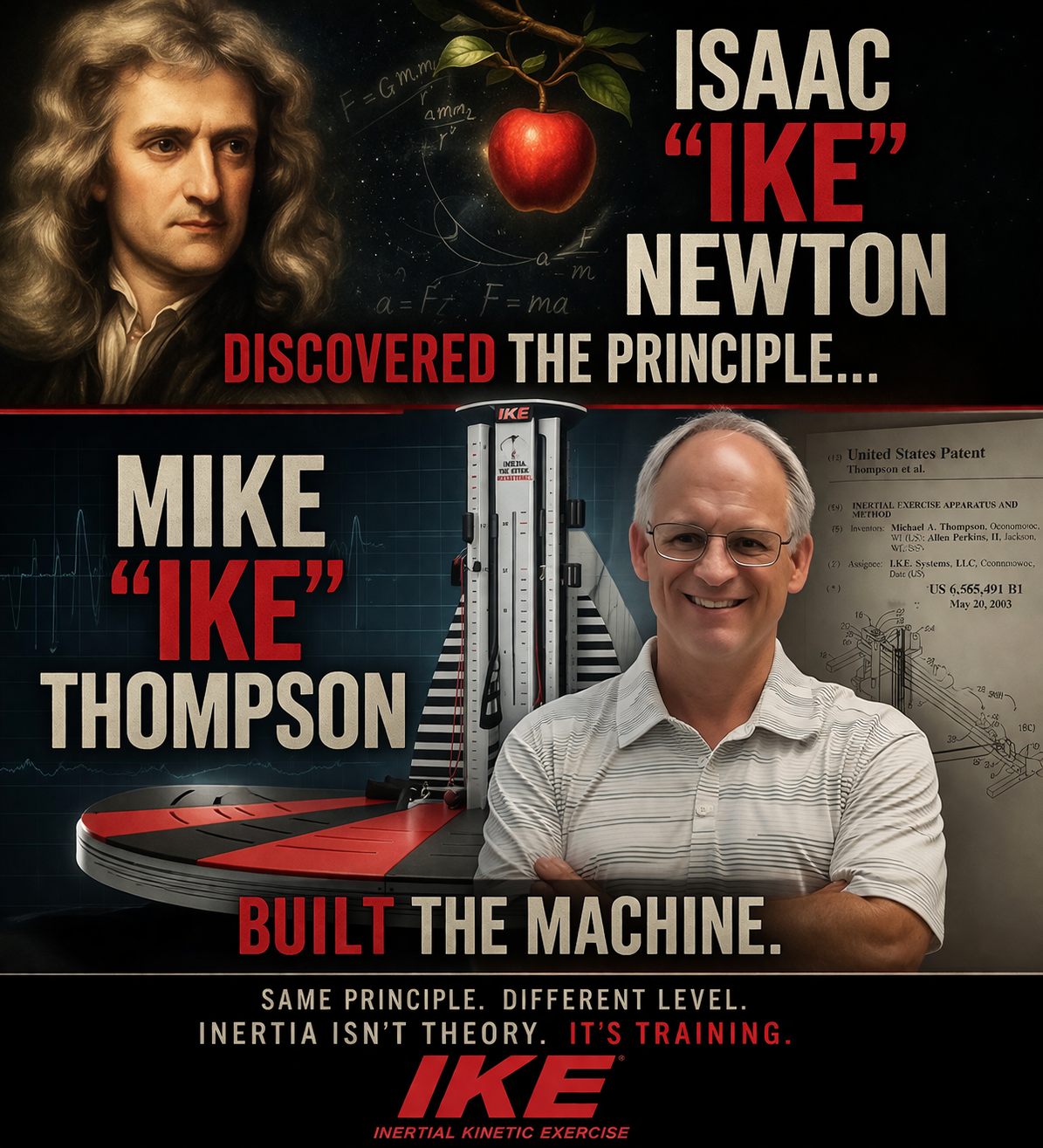
Isaac IKE Newton discovered the principle. Mike IKE Thompson built the machine.
6 Neurological Principles
1 Machine. All of them.
35+ Years in Development
US Patent Holder

The Principle Behind The Machine

Newton's Third Law of Motion laid the foundation. Three centuries later, one patent turned that principle into a training machine. Same physics. Different century. Different level.

See It In Action

THIS IS WHAT NEUROLOGICAL TRAINING LOOKS LIKE.

Speed · Rhythm · Timing · Stretch Reflex · All in one rep.

THE ANCIENT
GREEKS HAD IT RIGHT.

The body hasn't changed. The nervous system that controls it hasn't changed for eons. What's changed are the tools we have to affect it.

Plyo Greek origin To Increase

The word plyometrics comes from the ancient Greek — plyo meaning to increase, and metron meaning to measure. Literally: a measurable increase. The ancient Greeks understood intuitively what modern sports science has spent centuries proving — that explosive, elastic movement is the foundation of human athletic performance.

They trained it in the Olympic Games. They studied it in their gymnasiums. They didn't have the vocabulary of muscle spindles, Golgi tendon organs, or the stretch shortening cycle — but their bodies knew.

"The nervous system hasn't changed since the Greeks ran at Olympia. We're still working with the same hardware. The question is always: what software are we loading?"

The IKE Machine — Inertial Kinetic Exerciser — is the first machine ever designed specifically to train these ancient neurological principles with modern precision. Invented and patented by Mike Thompson, ATC, after 35 years of studying how the nervous system controls movement.

Ancient Greece · 776 BC

The Olympic Games

Greek athletes train explosive elastic movement — jump training, throwing, sprinting. Plyometrics in practice before the word exists.

1924 · Newton's Laws Applied

Force-Velocity Relationship

Sports scientists begin mapping the relationship between muscle force and velocity — the foundation of what would become the stretch shortening cycle.

1960s · Soviet Sports Science

Depth Jumps & Shock Training

Soviet coach Yuri Verkhoshansky formalizes plyometric training. The stretch reflex is identified as the key to explosive power development.

1980s–Present · Modern Neuroscience

Muscle Spindles & The GTO

Research identifies the muscle spindle and Golgi Tendon Organ as the gatekeepers of human movement. Train the reflex, train the performance.

2010s · Mike Thompson, ATC

The IKE Machine — Patented

After 35 years in sports medicine, Thompson invents and patents the first machine designed to train all six neurological performance principles simultaneously.

YOUR DOCTOR
ALREADY KNOWS
THIS WORKS.

When a doctor taps your patellar tendon, he isn't testing your strength. He's testing your nervous system. And there's a very specific reason he uses a small rubber hammer — not a large one. Not a slow one.

The Doctor's Hammer

Light. Quick. Precise.

The patellar reflex test works because of one principle — a light, quick stretch of the quadriceps tendon triggers an involuntary neurological response. The muscle spindles fire. The quadriceps contracts. The leg kicks.

He doesn't hit you with a sledgehammer. A large, slow force bypasses the reflex entirely and just compresses tissue. The magic is in the speed and lightness of the stimulus.

He isn't testing your muscle. He's testing the integrity of the neurological loop between your spinal cord and your muscle. A healthy reflex means a healthy nervous system.

1 Light quick tap on tendon
2 Muscle spindles fire instantly
3 Quad contracts — leg kicks
Same Principle

"With every rep, the reflex becomes more honed. The nervous system becomes more intact, more responsive. The muscle spindles begin to dominate — and the body remembers how to move the way it was designed to move."

— Mike Thompson, ATC · Inventor, IKE Machine

PROTECTED BY PATENT.
PROVEN SINCE 2003.

US Patent 6,565,491 B1 — the only machine ever designed and patented to train inertial eccentric muscle actions at functional speeds.

US Patent Grant Certificate
USPTO Grant
Official Certificate
Signed by the Director of the United States Patent and Trademark Office.
US Patent 6,565,491 B1
Inertial Exercise Apparatus
Inventor: Michael A. Thompson, ATC — Oconomowoc, WI. Filed Aug. 11, 2000. Granted May 20, 2003.
IKE Technologies original 1993 brochure
I.K.E. Technologies, Inc. © 1993
The Original Brochure
"Functional eccentric muscle actions at functional speeds." Milwaukee, WI — 30 years before the conversation caught up.
From the Patent Abstract — US 6,565,491 B1

"The inertial training apparatus and method allows for generation of rotational inertial forces by accelerating a mass by a concentric contraction of a muscle and converting the rotational inertial forces of the mass into a substantially equivalent eccentric action of the muscle used to decelerate the mass."

— United States Patent Office · Patent No. 6,565,491 B1 · May 20, 2003
IKE Machine in clinical use

THE SCIENCE IS ANCIENT.
THE MACHINE IS NEW.

35 years of clinical practice. A US patent. One machine that finally trains the nervous system the way the body was designed to move.

Get In Touch →

THE IKE MACHINE
IN MOTION.

Watch inertial kinetic exercise in clinical and athletic settings.

IKE Machine — Demo
IKE Machine — In Action
IKE Machine — Clinical Use